
Spanish Mortgage: 50% Debt-to-Income Ratio? Myth or Reality?

Introduction
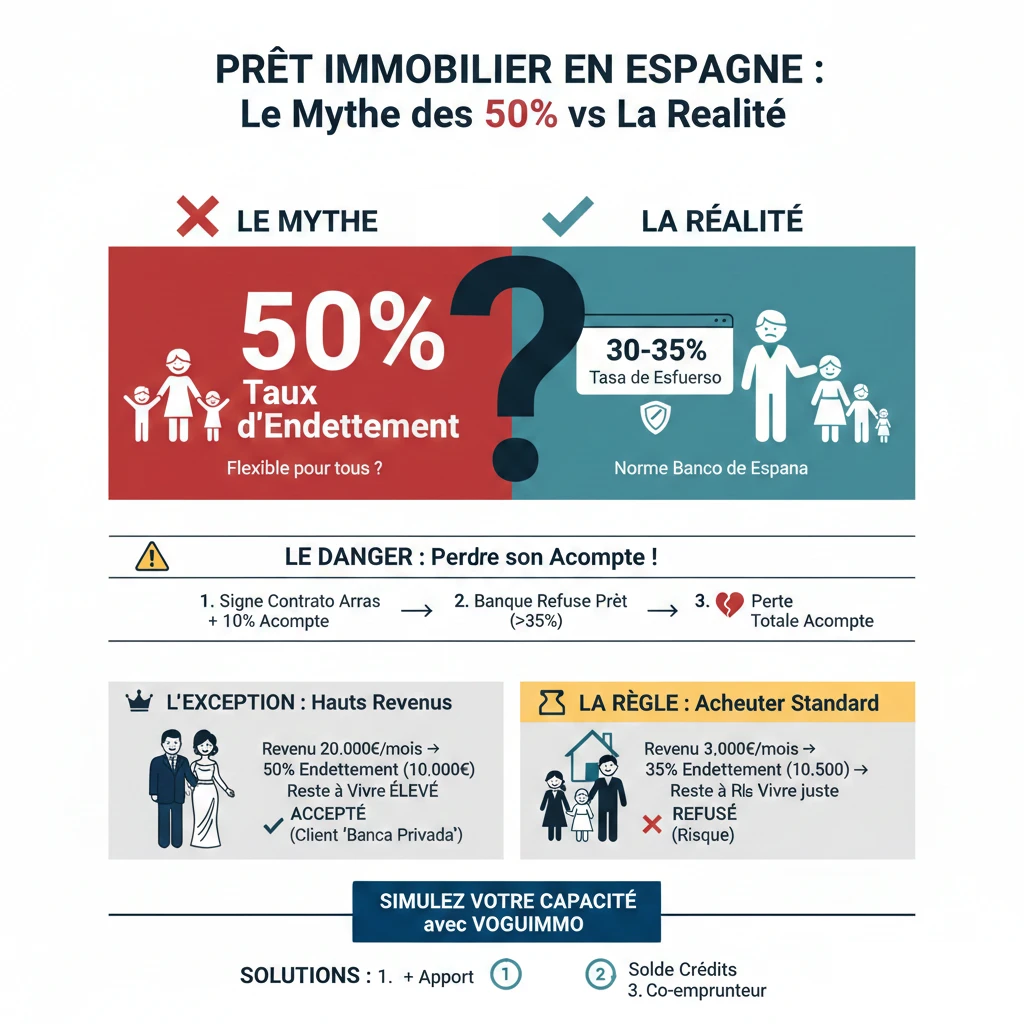
You may have heard that Spanish banks are more "flexible" than French banks and that it is common to obtain a mortgage there with a 50% debt-to-income ratio. In France, the French High Council for Financial Stability (HCSF) standard is a strict 35%, including insurance. This supposed difference attracts many investors, but it is more a myth than a reality for 99% of buyers. This is a critical financial topic that deserves your full attention.
As experts in financing in Spain, we see buyers taking huge risks based on this false belief. The danger? Signing a "Contrato de Arras" (preliminary sales agreement) and paying a 10% deposit, expecting to get a loan at a 50% debt-to-income ratio, only to have the financing refused and lose their entire deposit. The reality is that the Spanish standard is just as cautious as the French standard: it is between 30% and 35%.
The Golden Rule in Spain: The "Tasa de Esfuerzo" of 30-35%
Forget the 50% myth. The only figure that matters to a Spanish retail bank (Sabadell, CaixaBank, BBVA, Santander...) is your "Tasa de Esfuerzo" (debt-to-income ratio).
What is the "Tasa de Esfuerzo"?
It is the percentage of your net monthly income dedicated to repaying all your debts. To protect the financial system and borrowers, the Bank of Spain (Banco de España), the regulatory authority, strongly recommends that banks do not exceed a threshold of 30% to 35%. This caution is a direct lesson from the 2008 financial crisis that severely impacted Spain.

How do Spanish banks calculate this ratio?
The calculation is simple but strict. The bank adds up all your liabilities and divides them by all your stable incomes.
- Incomes considered: Net salaries (permanent contracts, civil servants), retirement pensions (a highly valued profile for its stability), rental income (generally weighted, the bank retains only 70% to 80% of rents received).
- Debts considered: Absolutely ALL your global debts. This includes your mortgages in your home country, car loans, consumer loans, alimony payments, and of course, the new monthly payment for your future Spanish loan.
| Borrower Profile | Net Monthly Income | Existing Debts (Home Country) | Max Monthly Payment Available for Spain |
|---|---|---|---|
| Couple A | €4,000 | €500 (Car Loan) | (€4,000 x 0.35) - €500 = €900 / month |
| Couple B | €6,000 | €1,000 (Home Mortgage) | (€6,000 x 0.35) - €1,000 = €1,100 / month |
Why 50% is a (very) rare exception, not a rule
So, where does this 50% myth come from? It originates from a confusion between "Retail Banking" and "Private Banking." For 99% of buyers, the 35% rule applies. The 50% exception only concerns very high-income profiles, and this is due to a different calculation.
The bank's true calculation: "Disposable Income" (El "Sobrante")
More than the debt-to-income percentage, the bank is interested in your "disposable income" (called sobrante or remanente in Spanish): how much do you have left in euros once all your expenses are paid?
The expert's key concept
A 50% ratio on an income of €3,000 leaves only €1,500 to live on. This is too high a risk of default for the bank.
However, a 50% ratio on an income of €20,000 leaves €10,000 to live on. The risk of default is nil. This is the only situation where a high debt-to-income ratio is conceivable.
The Exception: The "Banca Privada" Client (Private Banking)
If you have a very high financial net worth (generally more than €500,000 or €1,000,000 in assets), you are no longer a retail customer but a "Banca Privada" client. The rules are different. The bank may accept a 50% debt-to-income ratio because the risk is covered not only by your income but also by your assets (which can be pledged, or pignorado, as collateral).
| Client Profile | Net Monthly Income | Target Debt-to-Income Ratio | "Disposable Income" | Bank Decision |
|---|---|---|---|---|
| Standard Buyer | €3,500 | 35% (€1,225) | €2,275 | Accepted (if > threshold) |
| Standard Buyer | €3,500 | 50% (€1,750) | €1,750 | Refused (Disposable income too low) |
| Private Banking Client | €15,000 | 50% (€7,500) | €7,500 | Accepted (High disposable income) |
3 solutions if your debt-to-income ratio exceeds 35%
If your project takes you beyond the "official" 35%, don't give up. Here are three solutions we use with our clients to secure financing.
- Increase Your Down Payment (Aportación) This is the simplest and most effective solution. As a reminder, a non-resident must already provide a minimum down payment of 30% of the price (the bank only finances 70%) plus approximately 12-14% for fees. By increasing your down payment to 40% or 50%, you reduce the capital borrowed, and thus the monthly payment, which then falls within the 35% limit.
- Settle Existing Loans If you have a car loan or consumer credit in your home country that ends in 1 or 2 years, settle it early. This will immediately free up your borrowing capacity for your Spanish project.
- Add a Co-borrower (Cotitular) If you are buying alone but your income is a bit tight, adding a co-borrower (your spouse, a child) allows the bank to consider both incomes, thus increasing the calculation base for the 35%.

Official Resource
To understand the official recommendations on mortgage loans in Spain and borrower rights, the most reliable source is the Bank of Spain's customer portal.
Conclusion
The 50% debt-to-income ratio in Spain is a myth for the standard property buyer. Attempting to base your project on this idea is the quickest way to lose your 10% deposit. The only reliable rule for a mortgage is the "Tasa de Esfuerzo" of 35%.
Our experience is unequivocal: a property purchase project in Spain must begin with a realistic financing simulation. Never commit a deposit before having bank pre-approval based on the 35% rule. Your project must adapt to your repayment capacity, not the other way around.

Is Your Financing Secured?
Take advantage of market opportunities. Let's discuss your project.
Article Summary
- Introduction
- The Golden Rule in Spain: The "Tasa de Esfuerzo" of 30-35%
- What is the "Tasa de Esfuerzo"?
- How do Spanish banks calculate this ratio?
- Why 50% is a (very) rare exception, not a rule
- The bank's true calculation: "Disposable Income" (El "Sobrante")
- The Exception: The "Banca Privada" Client (Private Banking)
- 3 solutions if your debt-to-income ratio exceeds 35%
- Conclusion
FAQ: Debt-to-Income Ratio Myths and Realities for UK/US Investors in Spain
Understanding the True 35% Debt-to-Income Rule Before Signing a 'Contrato de Arras'.
No. This is a dangerous myth for 99% of international buyers. Basing your financial project on this false belief is the quickest way to have your loan refused and lose your deposit.
The golden rule is the "Tasa de Esfuerzo" (effort rate/debt-to-income ratio). To protect borrowers, the Bank of Spain (Banco de España) strongly recommends that retail banks do not exceed a threshold of 30% to 35%.
This is the Spanish equivalent of what's commonly known as the debt-to-income (DTI) ratio. It represents the percentage of your net monthly income that you dedicate to repaying all your debts (existing debts + future Spanish mortgage payment).
The danger is signing a "Contrato de Arras" (equivalent to a preliminary sales agreement or deposit contract) and paying the 10% deposit, believing that the financing will be approved. If the bank refuses the loan (because you exceed 35%), you risk losing the entire deposit.
They add up all your monthly financial commitments (including the future Spanish mortgage payment) and divide them by your stable net monthly income.
Yes, absolutely. Banks analyze ALL your global debts: mortgages in the UK, US, or elsewhere, car loans, consumer loans, alimony/maintenance payments, etc.
The bank considers stable income: net salaries (from permanent employment contracts) and retirement pensions. Rental income is generally weighted: the bank will only consider 70% to 80% of the rent you receive.
It stems from a confusion between retail banking (available to all) and "Banca Privada" (private banking). The latter may, in very rare cases, accept a 50% ratio for clients with very high incomes and significant assets.
These are individuals with very high financial net worth, typically over €500,000 or €1,000,000 in financial assets. The bank then uses these assets as collateral, in addition to their income.
This is the most important criterion for the bank, even more so than the percentage. It's the amount in euros you have left after all your monthly expenses are paid. A 50% ratio on an income of €3,000 (leaving €1,500) will likely be refused, whereas a 50% ratio on €20,000 (leaving €10,000) might be accepted.
This article identifies three main solutions:
-
Increase your personal down payment (Aportación) to reduce the borrowed amount.
-
Pay off existing loans (e.g., car loan, consumer credit) to free up borrowing capacity.
-
Add a co-borrower (Cotitular) to increase the combined income considered.
A non-resident must provide a minimum of 30% of the purchase price (as banks typically finance a maximum of 70%) plus approximately 12% to 14% to cover legal fees, taxes (including Stamp Duty where applicable), and processing fees.
Yes, the article states that retirement pensions are considered a "very stable and appreciated profile" by Spanish banks when calculating income.
This is the Spanish equivalent of a preliminary sales agreement or an earnest money contract. It's a private agreement between the buyer and seller where the buyer pays a deposit (often 10%) to 'reserve' the property. It is very difficult to recover this deposit if you withdraw from the purchase.
Expert experience is clear: you should never commit to a deposit (sign a "Contrato de Arras") before you have obtained a realistic pre-approval for financing from a bank, based on the 35% debt-to-income rule.


