Power of Attorney for Property Purchase in Spain (Poder Notarial)

Introduction
When you buy property in Spain, you cannot always be physically present to sign the deposit, the final deed before the notary, or obtain your NIE. This is where the notarial power of attorney, called "Poder Notarial", comes in. It is a powerful and common legal tool in Spain that involves your money and your signature.
Understanding this act is essential. As experts accustomed to these transactions, we see powers of attorney that protect buyers and others, too broad, that put them at risk. This guide explains the difference between a "Poder Especial" (recommended) and a "Poder General" (risky), how to obtain it from the UK, US or other countries, and the associated costs.
1. What is the "Poder Notarial"?
The "Poder Notarial" (notarized power of attorney) is a public document authorized by a notary that allows one person (the poderdante, or principal) to appoint another person (the apoderado, or agent) to act on their behalf in specific legal acts.
For a property purchase, this agent is most often your lawyer (abogado) or your gestor (administrative advisor). It is not a simple private 'power of attorney' but an official notarial deed.
The delegated tasks may include:
- Apply for and obtain your NIE (Foreigner Identification Number).
- Open a Spanish bank account.
- Sign the reservation contract or the "contrato de arras" (pre-purchase agreement).
- Sign the final deed of sale ("Escritura pública") before the notary.
- Carry out post-signature procedures (payment of taxes, registration in the Property Registry).
The Pitfall: "Poder Especial" (Special) vs "Poder General" (General)
This is the most critical distinction. Giving someone a "Poder General" means giving them the keys to your entire financial life in Spain. We formally advise against it for a simple purchase.
| Type of Power of Attorney | What it allows | Level of Risk |
|---|---|---|
| Poder General (General Power of Attorney) | Allows the agent to manage ALL your present and future assets (sell, buy, mortgage, manage all your bank accounts) without limit. | Extremely High. AVOID. |
| Poder Especial (Special Power of Attorney) | Limits the agent's action to precise and defined acts (e.g.: "Purchase the property located at such address", "Obtain the NIE"). | Low. Recommended by experts. |
2. Why use a Power of Attorney?
Using a "Poder Notarial" is a matter of practicality and efficiency. For a non-resident, it avoids multiple costly trips to Spain.
- Time-saving: You don't need to travel to obtain the NIE (which requires several appointments), nor for the final signature.
- Administrative efficiency: Your lawyer or gestor can carry out procedures (bank, notary, taxes) without delay.
- Security (if well-drafted): By using a "Poder Especial", you mandate a professional for technical tasks while retaining full control over the transaction (you validate the property and the price).

3. How to obtain a Power of Attorney (in Spain or from abroad)?
You have two main options for establishing this document, each with a different process.
Option 1: In Spain (The simplest)
If you are in Spain, even for a short visit, you can:
- Make an appointment with any Spanish notary.
- Come with your identification (Passport) and the complete information of your agent (Name, DNI/NIE, civil status).
- The notary drafts the "Poder Especial" according to your instructions (your lawyer can provide a draft).
- You sign. The document is immediately valid in Spain. Cost: approximately 60 € to 150 €.
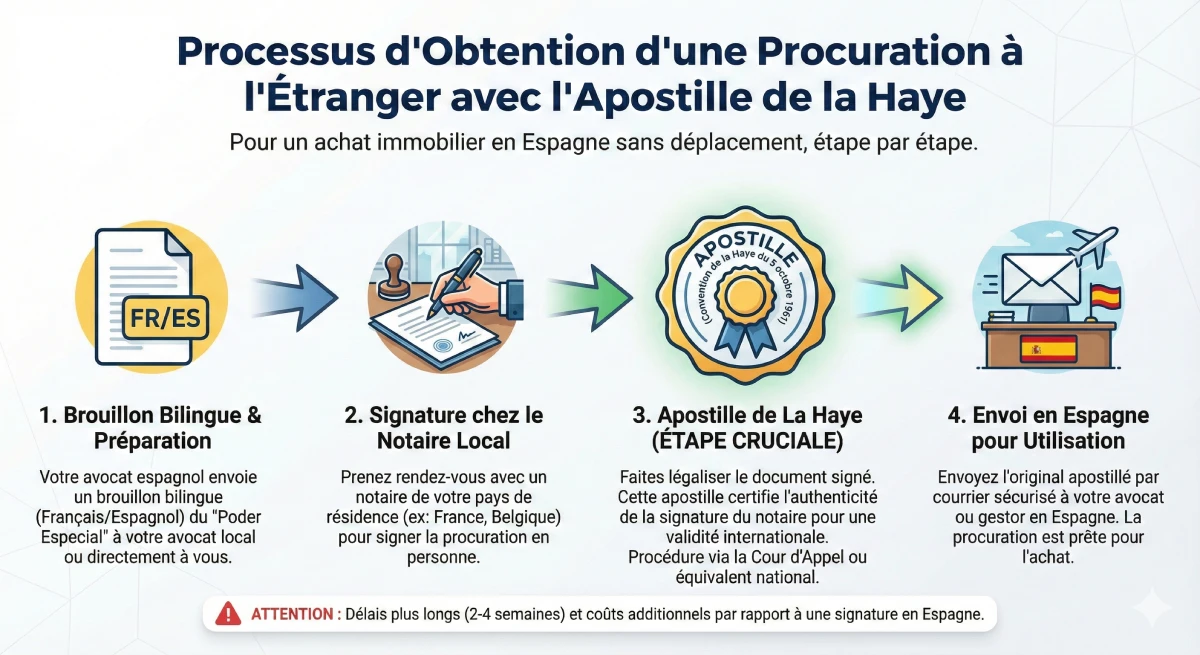
Option 2: From abroad (UK, US, etc.) via the Apostille
If you cannot travel, you can do it from your country of residence. Be aware, the process is longer.
- Your Spanish lawyer sends you a bilingual draft (English/Spanish) of the "Poder Especial".
- You make an appointment with a notary in your country (e.g., a UK or US notary).
- You sign the power of attorney before this notary.
- CRUCIAL STEP: The document is not yet valid in Spain. You must have it "legalized" by obtaining the Hague Apostille.
- The Apostille is an official stamp that certifies the authenticity of the notary's signature.
- You then send the original apostilled document to your lawyer in Spain.
Official Resource
The Apostille is a standardized international procedure. The specific authority for obtaining an Apostille varies by country (e.g., Foreign, Commonwealth & Development Office in the UK, Secretary of State in the US). The process is now largely digitized.
4. Risks, Costs, and Expert Advice
The "Poder Notarial" is an act of absolute trust. Your agent can sign a loan or a purchase on your behalf. The main risk is abuse of trust.
Expert Advice
Never give a "Poder General". Always demand a "Poder Especial" prepared by your lawyer, limiting the powers to: The purchase of a specific property (or in a defined area). A maximum purchase price. The inability to mortgage the property (unless you request a loan). Never give power of attorney to a party with a conflict of interest (such as the seller's real estate agent or a developer).

| Procedure | Estimated Cost | Timeframe |
|---|---|---|
| Power of Attorney in Spain | €60 - €150 (depending on notary and complexity) | Immediate |
| Power of Attorney from abroad | €150 - €300 (Local notary + Apostille fees) | 2 to 4 weeks |
Conclusion
The "Poder Notarial" is a fantastic legal instrument for buying property in Spain with complete peace of mind, provided it is used correctly. It allows you to delegate complex administrative procedures without losing control, while ensuring the legal security of the transaction.
Our experience shows that the key is to opt for a strict "Poder Especial", drafted by an independent lawyer who defends your interests. By including this option in your strategy, you save time and avoid unnecessary travel, making your property purchase project in Spain much smoother.

Need help with your Power of Attorney?
Take advantage of market opportunities. Let's discuss your project.
Article Summary
- Introduction
- 1. What is the "Poder Notarial"?
- The Pitfall: "Poder Especial" (Special) vs "Poder General" (General)
- 2. Why use a Power of Attorney?
- 3. How to obtain a Power of Attorney (in Spain or from abroad)?
- Option 1: In Spain (The simplest)
- Option 2: From abroad (UK, US, etc.) via the Apostille
- 4. Risks, Costs, and Expert Advice
- Conclusion
FAQ: Your Guide to Notarial Power of Attorney in Spain
Deepen your understanding of the "Poder Notarial" (Notarial Power of Attorney) with these 15 expert answers to secure your remote property transaction in Spain.
In principle, no. A "Poder Notarial" remains valid indefinitely unless it is revoked, or if an end date is explicitly stated in the document. For a property purchase, we recommend including a validity clause (e.g., 12 months) for security.
Yes, at any time. You must go to a notary to sign a deed of revocation (escritura de revocación). You must then imperatively notify the attorney-in-fact (by registered mail or formal legal notice) so that they cease using the previous power.
Absolutely, it's very common. If a couple is buying but only one spouse can travel to Spain for the signing, the other can grant them a power of representation. This avoids travel expenses for two people.
Yes, if it is drafted only in English. To avoid high costs for a certified translation, ask your solicitor or attorney in your home country to sign a bilingual (dual column) document prepared in advance by your Spanish lawyer.
No. The Power of Attorney allows signing, not financing. You will need to transfer the necessary funds (price + fees) to your lawyer's client account or to your own Spanish bank account if the power allows them to issue banker's drafts on your behalf.
Yes. Consuls act as Spanish notaries. The advantage is that the document is directly in Spanish (no Apostille needed). The disadvantage is that it is often very difficult to get an appointment quickly at various consulates abroad.
Yes, but only if the "Poder" (Power of Attorney) expressly states it. Banks are very strict: the clause must detail the maximum loan conditions (rate, duration, amount) for the bank to accept signing by power of attorney.
The general rule in Spain (Civil Code) is that the mandate terminates upon the death of the principal. The Power of Attorney is no longer valid for the heirs, who will have to manage the inheritance themselves or establish new powers.
Yes. On the day of the final signing, the attorney-in-fact must present the certified copy (Copia Autorizada) of the Power of Attorney (along with the original Apostille, if applicable). A PDF copy or a photocopy is not sufficient.
Yes. You can appoint multiple attorneys-in-fact (for example, two lawyers from the same firm). It is preferable to specify that they can act "severally" (either one independently) for greater flexibility.
It has become complicated due to anti-money laundering (AML) laws. Many banks require the client's physical presence at least once ("Know Your Customer"). Always check with the bank before signing the Power of Attorney.
While the cost of an Apostille varies by country (e.g., typically between £20-£50 or $20-50), the main expense is usually the notary's fee for drafting and signing the document.
It is strongly recommended. In a "Poder Especial" (Special Power of Attorney), you can include a clause stating: "To purchase property X at a maximum price of Y euros". This protects you against any negotiation or price change to your disadvantage.
Yes. A well-drafted Power of Attorney includes clauses to manage utility and service contracts (water, electricity, gas, internet, community administrator). This allows your lawyer to transfer these contracts into your name without you having to call Spanish providers.