Affordable Coastal Homes in Spain: Your 2025 Guide

Introduction
The "dream of buying an affordable beachfront home in Spain" seems increasingly out of reach for many. With prices soaring in popular markets like the Costa del Sol or the Balearic Islands, many international investors believe this project has become unattainable. This represents a significant financial commitment, and an ill-informed choice of location can prove expensive.
As trusted experts in the Spanish real estate market, we can confidently state: this dream remains fully accessible in 2025. The key lies in strategic location scouting. Prioritize specific regions where the price per square meter remains consistently below €1,500. Reputable platforms like Voguimmo continue to feature properties priced under €100,000 across the Costa de Almería, the Costa Cálida (Murcia), and the southern Costa Blanca, often requiring just a short drive or walk from the primary beaches.
Top 5 Most Affordable Coastal Regions (2025)
If you are seeking an affordable beachfront property for sale in Spain, the following regions present the optimal balance of value and quality. These areas are perfectly suited for acquiring a second home or for a well-managed rental investment.
- Costa de Almería (Andalusia): The champion of low prices. Towns like Roquetas de Mar or El Ejido offer sea-view apartments starting from €70,000.
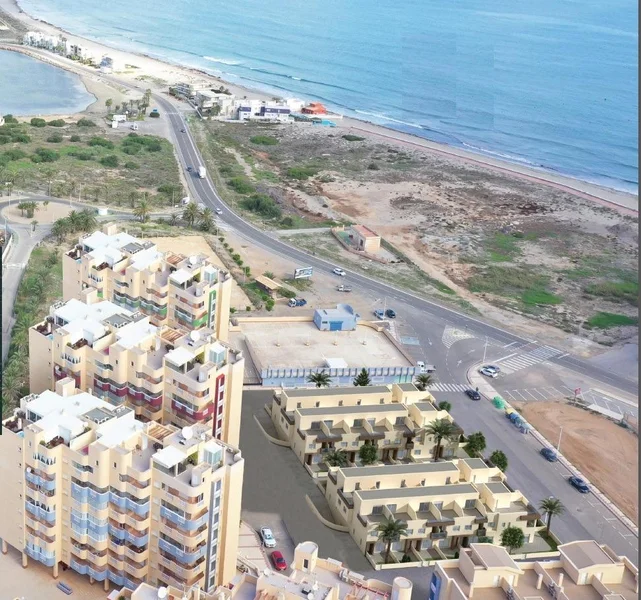
- Costa Cálida (Murcia): Around the Mar Menor, prices are very attractive. It's an ideal destination for a quiet retreat with warm, shallow waters.
- Costa del Azahar (Castellón): North of Valencia, towns like Vinaròs offer properties 30% cheaper than the national average, alongside superb beaches.
- Costa Blanca (South): While the northern parts (Javea, Dénia) are expensive, the south (Torrevieja, Guardamar) remains a very accessible price pocket and extremely popular with European expatriates and investors.
- Costa de la Luz (Huelva): On the Atlantic coast, near Portugal. Properties here are very accessible, featuring a wilder character and less overdevelopment.
Pros and Cons of Affordable Regions
Choosing a budget-friendly area naturally involves certain trade-offs. Here's an expert analysis to inform your decision.
| ✅ Key Advantages | ⚠️ Points to Consider |
|---|---|
| Very low price per m² (strong potential for capital appreciation). | Infrastructures (hospitals, international airports) sometimes further away. |
| Reduced local cost of living (restaurants, services). | Rental demand can be highly seasonal. |
| More authenticity and less overdeveloped areas. | Less economic dynamism or off-season activities. |
Price per m² Comparison by Region (2025 Estimation)
The difference in price per square meter is the best indicator for understanding the market. Here's a comparison between affordable areas and the national average.
| Region / Costa | Average Price (€/m²) | Budget for a 2-Bed Property (70m²) |
|---|---|---|
| Costa de Almería | ~ 1,050 € | ~ 73,500 € |
| Costa Cálida (Murcia) | ~ 1,180 € | ~ 82,600 € |
| Costa del Azahar (Castellón) | ~ 1,250 € | ~ 87,500 € |
| Costa Blanca (South) | ~ 1,400 € | ~ 98,000 € |
| Spain National Average | ~ 2,080 € | ~ 145,600 € |
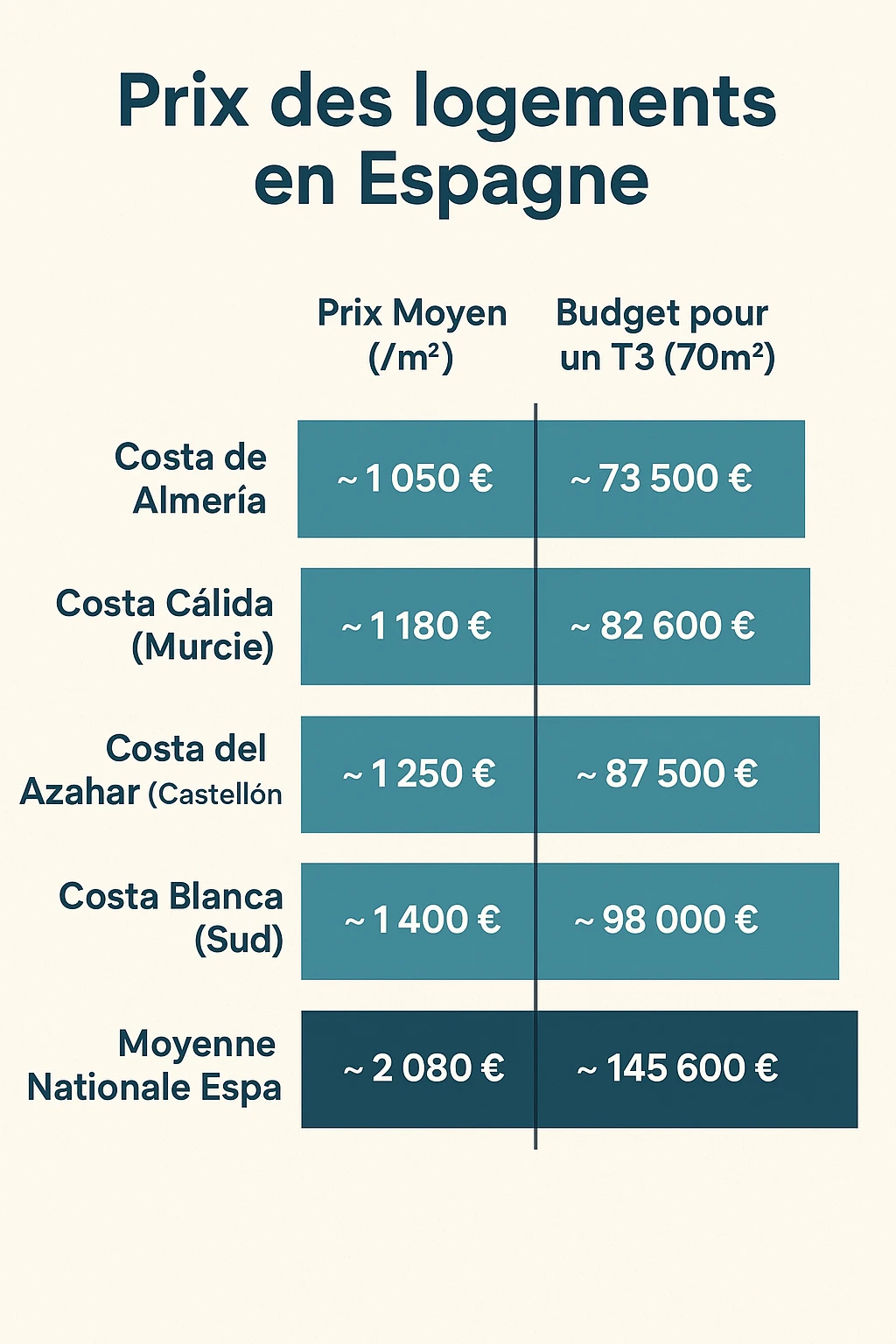
Expert Insight: Investing in property on these affordable Spanish coasts can save you approximately €1,000 per square meter compared to equivalent French coastal regions (e.g., Occitanie).
3 Strategies to Secure a Home Under €100,000
Even within these budget-friendly regions, truly exceptional opportunities are not always overtly advertised. Here are three expert strategies to uncover properties that are often overlooked by the general public.
1. The "15-Minute Rule" (Location Compromise)
It's unrealistic to expect an €80,000 apartment right on the "front line", directly overlooking the water. However, by being open to a 15-minute walk or a 5-10 minute drive to reach the beach, property prices can decrease by 20% to 30%. This represents an optimal compromise for balancing your budget with your desire for coastal living.
2. Target Bank Repossessions (Viviendas de bancos)
Spanish banks (such as Santander, BBVA, and Caixabank) continue to hold portfolios of repossessed real estate assets (known as "embargos"). They are motivated to liquidate these properties swiftly, frequently offering them below typical market value. While these properties may occasionally require some renovation, the potential for a substantial discount is genuine. This presents a critical opportunity for investors seeking strong capital appreciation.
You can find them on dedicated portals or via platforms like Idealista's "Bank Properties" filter, an authoritative source in the market.

3. Utilize Effective Portal Filters
Don't just type "beach house." Use advanced filters on property portals: sort by "Precio más bajo" (lowest price) and specifically target the provinces of Murcia and Almería. You'll be surprised by the volume of available properties.
Tip: Never Forget the 10-15% Fees!
A property advertised at €90,000 will realistically cost you between €99,000 and €103,500. Always factor in an additional 10% to 15% above the purchase price to cover ITP (property transfer tax), notary fees, legal counsel, and registration. This golden rule ensures you avoid any unexpected financial outlays.
Conclusion
Indeed, the aspiration of acquiring an affordable beachfront home in Spain remains a tangible reality in 2025. The key strategy is to bypass the overtly "Instagrammable" and often overpriced areas, instead focusing on high-potential regions with more accessible pricing, such as the Costa de Almería and the Costa Cálida (Murcia).
By diligently applying these informed strategies (such as being open to a short commute and monitoring bank repossessions) and leveraging the guidance of experts deeply familiar with these markets, you can effectively locate quality properties for under €100,000.

Exploring a Property Under €100,000?
Take advantage of market opportunities. Let's discuss your project.
Table of Contents
- Introduction
- Top 5 Most Affordable Coastal Regions (2025)
- Pros and Cons of Affordable Regions
- Price per m² Comparison by Region (2025 Estimation)
- 3 Strategies to Secure a Home Under €100,000
- 1. The "15-Minute Rule" (Location Compromise)
- 2. Target Bank Repossessions (Viviendas de bancos)
- 3. Utilize Effective Portal Filters
- Conclusion
FAQ: Buying an Affordable Beachfront Property in Spain
All your questions answered for smart investing in 2025
Spain stands out as one of Europe's most sought-after and affordable destinations. It offers a perfect balance of a sunny climate, high quality of life, and a real estate market with prices significantly lower than in many other European countries, especially for properties located along its extensive Mediterranean coasts.
For an affordable holiday or residence, the Costa de Almería (Andalusia) and Costa Cálida (Murcia) are prime destinations. Towns like Roquetas de Mar, Águilas, or the areas around the Mar Menor offer superb beaches and a cost of living (restaurants, groceries) approximately 20 to 30% lower than the Costa del Sol or Costa Brava.
In 2025, the province of Almería remains Spain's most affordable coastal area, with an average price per square metre nearing €1,050. The province of Castellón (Costa del Azahar), north of Valencia, and the Murcia region follow closely, offering numerous opportunities below €1,200/m².
The average property price in Spain is around €2,080/m² (national average 2025). However, this figure conceals significant disparities. On popular coasts (Marbella, Ibiza), prices can exceed €4,000/m², while inland in the Southern Costa Blanca or Almería, village houses or apartments can be found between €800 and €1,300/m².
Yes, it's absolutely possible, but you'll need to make some concessions. For this budget, you'll mainly find:
- One or two-bedroom apartments in older residential blocks (1980s-1990s) without a lift.
- Properties located 10 to 15 km from the beaches (in the hinterland).
- Properties requiring renovation work. Areas like Torrevieja, Gandía, or Vinaròs are full of offers in this price range.
The Southern Costa Blanca (around Torrevieja and Orihuela Costa) is ideal for retirees on a budget. The international community is strong there, healthcare services are excellent, and property is very accessible. The Costa Cálida (Murcia) is an excellent alternative for those who prefer more tranquility and warmer waters.
According to 2025 data, here are the top affordable coastal towns:
- Ferrol (Galicia) - Although on the Atlantic, it's very cheap.
- Gandía (Valencia) - Excellent value for money on the Mediterranean.
- Cartagena (Murcia) - Historic city with low prices.
- Algeciras (Andalusia).
- Vinaròs (Castellón).
Bank repossessions (or "embargos") are often sold 20 to 40% below market price. To find them, you should check the property portals of Spanish banks (such as Haya Real Estate, Altamira, Solvia) or go through a specialized real estate agency that has access to these listings before they are released to the general public.
You should budget an additional sum of approximately 10% to 13% of the sale price. This includes:
- Property Transfer Tax (ITP): This is similar to Stamp Duty and ranges from 6% to 10% depending on the region.
- Notary fees and Land Registry fees.
- Legal fees for your solicitor or administrative agency (gestoría).
Yes, because although prices are increasing slightly, they remain significantly lower than in many other European countries. Furthermore, rental demand is very strong, ensuring good profitability if you don't live there all year round. Interest rates are also starting to stabilize, making credit more accessible.
These regions have long suffered from a lack of infrastructure (less well-served airports, newer motorways) compared to Alicante or Malaga. Additionally, there is an abundant supply of new construction. This 'tourism delay' is now a boon for buyers seeking authenticity at an affordable price.
The phenomenon of squatters (known as 'okupas') exists but is often disproportionately covered by the media. It mainly concerns abandoned properties belonging to banks. To secure an 'affordable' purchase, prioritize gated communities, install an alarm connected to the police, and avoid marginalized neighbourhoods. A local agent will be able to guide you.
The difference is notable. The Costa Brava is expensive, with prices often exceeding €3,000/m² for a sea view. The Costa Blanca (Alicante), located further south, offers equivalent properties for 30% to 50% less, thanks to a wider range of properties and a lower cost of living.
Once you own a property, the annual charges are generally low. You will need to pay the IBI (Impuesto sobre Bienes Inmuebles), which is the local property tax, similar to Council Tax in the UK or property tax in the US. This is generally much cheaper than in many other European countries, typically ranging from €200 to €600 per year for an average apartment. There are also community fees (gastos de comunidad) if your property is part of a residential complex.
Building plots on the 'first line' (frontline beach) are rare and expensive. However, by moving a few kilometers inland (in provinces like Alicante or Valencia), you can find affordable plots (sometimes starting from €30,000). Be aware, however, that construction costs have increased, as have administrative delays for obtaining permits.