
Living and Buying in Mallorca, The 2025 Real Estate Guide

Introduction
Mallorca, the largest of the Balearic Islands, continues to captivate investors and expatriates worldwide. In 2025, living and buying in Mallorca represents more than just a lifestyle investment: it's a strategic patrimonial choice in one of the Mediterranean's most resilient markets. The island has evolved to offer modern infrastructure while preserving its natural charm, from the Serra de Tramuntana to its turquoise coves.
However, Mallorca's real estate market is complex and highly segmented. Between soaring prices in the southwest and strict restrictions on tourist rental licenses, it's crucial to be well-informed before making a move. This 2025 real estate guide deciphers current trends, prices by zone, and essential steps to successfully relocate or invest on this exceptional island.
Why Choose Mallorca: An Unparalleled Lifestyle
Choosing Mallorca means opting for a superior quality of life. Unlike other island destinations that quiet down in winter, Mallorca thrives year-round. Palma, its capital, is a cosmopolitan metropolis connected to all of Europe thanks to its international airport (Son Sant Joan), Spain's third largest by passenger volume. The climate is ideal, with over 300 days of sunshine per year, promoting an outdoor lifestyle, watersports, and golf.
The island offers a rare duality: a sophisticated urban life in Palma, with its luxury boutiques and Michelin-starred gastronomy, and an authentic rural tranquility in inland villages such as Valldemossa or Pollença. This diversity attracts families seeking international schools, active retirees, and digital nomads alike.
The 2025 Real Estate Market: Prices and Key Zones
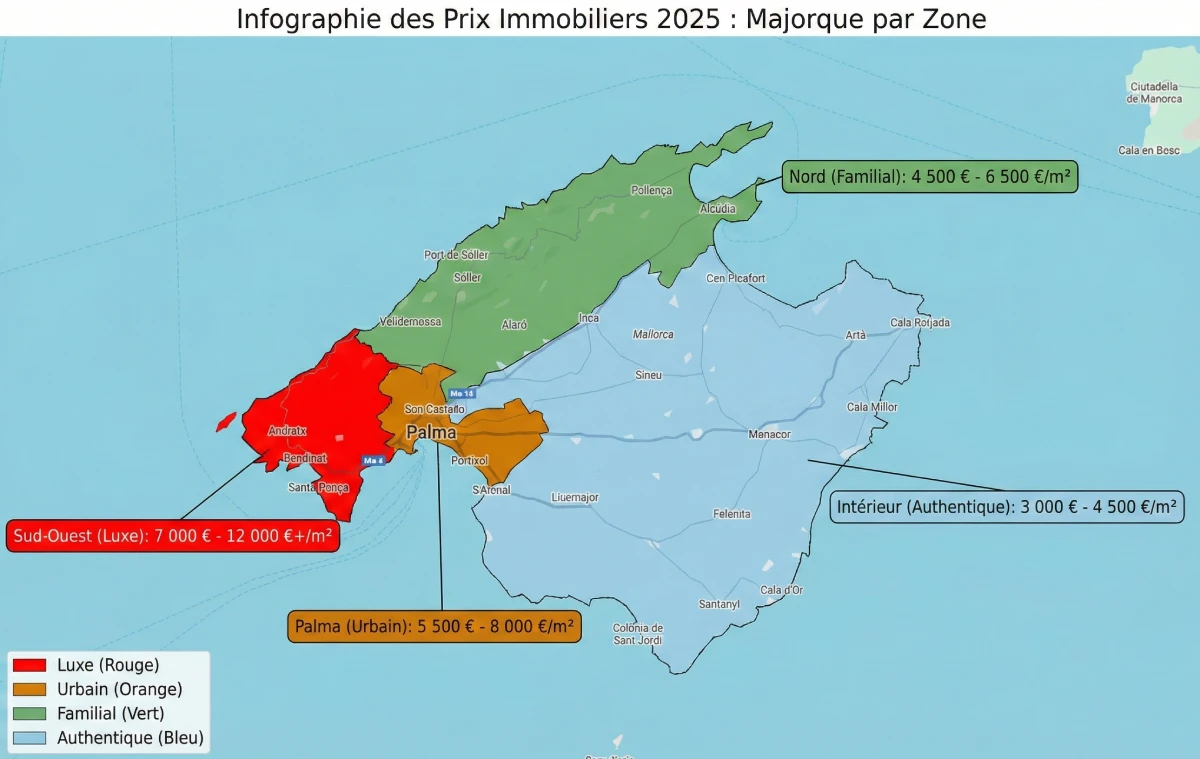
In 2025, Mallorca's real estate market is characterized by a stabilized prices at a high level. Foreign demand (German, British, Scandinavian, and French) remains the primary driver, absorbing a diminishing supply. There is a significant premium for renovated and energy-efficient properties, as well as those with a tourist rental license (ETV), which has become the "Holy Grail" for investors.
| Geographic Zone | Neighborhood Profile | Estimated Average Price (€/m²) |
|---|---|---|
| Palma (Center & Portixol) | Urban life, historic, beachfront | 5 500 € - 8 000 € |
| Southwest (Andratx, Bendinat) | Luxury, exclusive villas, marinas | 7 000 € - 12 000 €+ |
| North (Pollença, Alcúdia) | Family-friendly, nature, sandy beaches | 4 500 € - 6 500 € |
| Inland (Inca, Sineu) | Authentic, Fincas, peaceful | 3 000 € - 4 500 € |
It's essential to understand the price geography to target your search effectively. The Southwest remains the most expensive area, while the inland regions still offer attractive opportunities for those seeking space and authenticity.
Purchase Process and Regulations
Buying in Mallorca requires navigating specific administrative and tax particularities unique to the Balearic Islands. The first essential step is obtaining your NIE (Foreigner Identification Number). Without this vital document, no transaction is possible.
"Pay close attention to local taxation: The ITP (Property Transfer Tax) in the Balearic Islands is progressive and can reach 13% for luxury properties, one of the highest rates in Spain. Always factor in approximately 10-12% for additional costs into your overall budget." – Balearic Real Estate Expert.
Here are the key steps to secure your purchase:
- Legal Verification (Due Diligence): Ensure the property has no urban planning infringements (very common in rural areas).
- Reservation Contract (Arras): Binding commitment with a 10% deposit of the price.
- Title Deed (Escritura): Signing before a notary and payment of the balance.
- ETV License: Verify if the property has a valid license if you intend to rent it out.
Cost of Living and Relocation
Living in Mallorca entails a slightly higher cost of living compared to the Iberian Peninsula, due to its insular nature impacting consumer goods and energy prices. However, it remains competitive compared to major Northern European capitals or Paris.
| Expense Item | Comparison (vs Peninsula) | Note |
|---|---|---|
| Food | +10% to +15% | Prioritize local products (km 0) |
| Fuel / Transport | +5% to +10% | Car essential outside Palma |
| Real Estate | +30% to +50% | Highly distinctive premium market |
| Leisure / Restaurants | Variable | Similar, except for highly touristy areas |
Conclusion
Living and buying in Mallorca in 2025 remains a secure investment and an exciting life project. While prices demand a substantial budget, legal security, market stability, and an exceptional quality of life justify this financial commitment. Whether you're looking for a sea-view apartment in Palma or a renovated Finca inland, the key to success lies in guidance from local experts to avoid urban planning and legal pitfalls.

Planning to Buy in Mallorca?
Take advantage of market opportunities. Let's discuss your project.
FAQ: Investing and Living in Mallorca in 2025
Investing in real estate in Mallorca in 2025 represents a strategic asset opportunity. Understand the market, taxation, and specific Balearic regulations to ensure the success of your project.
Mallorca, the largest of the Balearic Islands, is far more than just a leisure destination. In 2025, it asserts itself as a strategic asset choice thanks to its resilient market and modern infrastructure. The island combines preserved natural charm, from the Serra de Tramuntana to its turquoise coves, with a dynamic cosmopolitan life in Palma.
Its appeal lies in its superior quality of life, an ideal climate with over 300 days of sunshine per year, and excellent European connectivity via Palma Airport (Son Sant Joan).
Mallorca offers an unparalleled quality of life that attracts a wide range of investors and expatriates. Unlike many islands, Mallorca is active all year round, especially its capital, Palma. Key assets include:
- An exceptional Mediterranean climate, ideal for outdoor activities like boating and golf.
- A sophisticated urban life in Palma, rich in culture, Michelin-starred gastronomy, and luxury boutiques.
- Authentic rural tranquility in picturesque villages such as Valldemossa or Pollença.
- Modern infrastructure and renowned international schools, perfect for families.
This unique duality satisfies families as well as active retirees or digital nomads.
In 2025, the real estate market in Mallorca is characterized by price stabilization at a high level. Foreign demand, particularly from German, British, Scandinavian, and other international buyers, remains the main driver and absorbs a dwindling supply. It is important to note that a significant premium is given to renovated, energy-efficient properties, and especially to those with a tourist rental license (ETV), a true Holy Grail for the investor.
The market is also highly segmented, with significant price disparities between the different geographical areas of the island.
It is essential to understand the price geography to effectively target your search in Mallorca. Here is an overview of the key areas and their profiles:
- Palma (Centre & Portixol): Ideal for urban and historic living, by the sea, with estimated prices between €5,500 and €8,000/m².
- South-West (Andratx, Bendinat): The most luxurious area, sought after for its exclusive villas and marinas, with prices that can exceed €12,000/m².
- North (Pollença, Alcúdia): A more family-friendly atmosphere, close to nature and sandy beaches, with prices ranging from €4,500 to €6,500/m².
- Interior (Inca, Sineu): Offers a more authentic and quiet Mallorca, with traditional Fincas, and more affordable prices from €3,000 to €4,500/m².
The South-West remains the most expensive area, while the inland areas still offer excellent opportunities for those seeking space and authenticity.
While promising, real estate investment in Mallorca has specificities and pitfalls to avoid. Points of vigilance include:
- Planning infractions (infractions urbanísticas): This is a very common issue, especially for rural properties (fincas). Thorough legal due diligence is essential.
- High taxation: The Property Transfer Tax (ITP) in the Balearic Islands is progressive and can reach up to 13% for luxury properties.
- Tourist rental licenses (ETV): Obtaining them is now extremely difficult, if not impossible, in some areas. Never purchase based on the promise of seasonal rental income without verifying the prior existence and validity of the ETV license.
Guidance from local experts is crucial for navigating these complexities.
The first and most crucial administrative step for any international buyer in Mallorca is obtaining a NIE (Número de Identificación de Extranjero - Foreigner Identification Number). This number is your tax and administrative ID in Spain, and it is absolutely essential. Without it, no real estate transaction is possible, whether it's to sign a reservation contract, the escritura (public deed), or even to open a Spanish bank account.
Real estate purchase taxation in the Balearic Islands is a major factor to consider. The main tax is the Property Transfer Tax (ITP - Impuesto de Transmisiones Patrimoniales), which applies to resale properties. In the Balearic Islands, this tax is progressive and can reach significant rates, sometimes up to 13% for luxury properties.
It is crucial to factor this high taxation into your budget, in addition to other ancillary costs (notary fees, Land Registry fees, legal fees), which generally represent between 10% and 12% of the total purchase price of the property.
Beyond the property's purchase price, ancillary costs are unavoidable and must be carefully budgeted. We generally advise allocating approximately 10% to 12% of the purchase price to cover all these expenses. They include:
- The Property Transfer Tax (ITP), whose rate varies depending on the property's value.
- Notary fees for signing the escritura (public deed).
- Fees for registration with the Land Registry (Registro de la Propiedad).
- Your solicitor's or legal advisor's fees, essential for rigorous due diligence.
- Any bank fees if you contract a mortgage loan.
These fees may vary slightly, but this estimate provides a solid basis for your provisional budget.
The process of purchasing a real estate property in Mallorca follows several structured steps, which we recommend you undertake with the help of an expert:
- Obtaining the NIE: Essential for any transaction in Spain.
- Legal Due Diligence: A solicitor examines the legal, planning, and tax situation of the property.
- Reservation Agreement (Contrato de Arras): A firm commitment from the buyer and seller, often with a 10% deposit of the purchase price.
- Signing the Public Deed (Escritura): Before a public notary, the balance of the price is paid, and ownership is transferred.
- Registration with the Land Registry: The property is officially registered in your name.
- Declaration and payment of taxes: Notably the Property Transfer Tax (ITP) and other local taxes.
- ETV License Verification: If the investment includes tourist rentals, ensure the validity of the existing license.
Each step is crucial to secure your investment.
A tourist rental license, or ETV (Estancia Turística Vacacional - Tourist Holiday Stay), is a legal authorization issued by the Balearic government that allows a property to be rented for short-term or seasonal purposes. It is absolutely crucial for any investor wishing to generate rental income through seasonal rentals in Mallorca.
Without a valid ETV license, any rental to tourists is illegal and subject to heavy fines. It has become a highly sought-after asset as it guarantees the legality and potential profitability of your rental investment.
No, it is currently extremely difficult, if not impossible in some areas of Mallorca, to obtain a new tourist rental license (ETV). A moratorium has been put in place by the Balearic authorities to regulate the seasonal rental market.
Therefore, for any rental investment project in Mallorca, it is imperative to target properties that already possess an existing and valid ETV license. Do not count on obtaining a new license in the future, as regulations are very restrictive and unlikely to become more flexible.
Legal verification, or Due Diligence, is a fundamental and non-negotiable step in the real estate purchase process in Mallorca. It involves a thorough examination of all legal, planning, and tax aspects of the property by a specialized solicitor.
This includes verifying:
- The legality of the construction and the absence of planning infractions.
- The absence of encumbrances, mortgages, seizures, or debts on the property.
- The property's conformity with the Cadastre (land registry) and the Land Registry (Registro de la Propiedad).
- The validity of permits and licenses, especially the tourist rental license (ETV) if applicable.
- The tax situation of the seller and the property.
This process guarantees the legal security of your acquisition and prevents future risks.
Living in Mallorca entails a slightly higher cost of living compared to the Iberian Peninsula. This difference is mainly due to its insular nature, which affects the prices of consumer goods and energy. However, Mallorca remains very competitive compared to many major European capitals.
Here is a comparison of key expenditure items:
| Expense Item | Comparison (vs Peninsula) | Note |
|---|---|---|
| Groceries | +10% to +15% | Prioritize local produce (km 0) |
| Fuel / Transport | +5% to +10% | Car essential outside Palma |
| Real Estate | +30% to +50% | Highly marked premium market |
| Leisure / Restaurants | Variable | Similar, except in very touristy areas |
Overall, although real estate is significantly more expensive, other expense items remain manageable with good knowledge of the local market.
Yes, living and buying in Mallorca in 2025 remains a secure investment and a very attractive life project. Despite a significant budget required for acquisition, the legal security of the Spanish market, price stability, and the island's exceptional quality of life justify this financial effort.
Mallorca's international appeal ensures continuous demand and solid asset appreciation in the long term. Whether you are looking for a primary residence, a luxury villa, or a rental investment, the island offers a wide diversity of properties with strong potential.
Being assisted by local experts is key to the success of any real estate acquisition project in Mallorca. The market is complex and highly segmented, with legal and planning specificities unique to the Balearic Islands.
A local expert, such as Voguimmo, will help you to:
- Navigate the market's intricacies and identify the best opportunities.
- Avoid planning and legal pitfalls (infractions, ETV licenses).
- Understand local taxation and optimize your investment.
- Ensure rigorous due diligence and secure your transaction.
- Save time and gain peace of mind throughout the process.
Their in-depth local knowledge is essential for a smooth and successful purchase.


