
Valencia, Spain Weather Guide

Introduction
Understanding the weather in Valencia, Spain is fundamental, not only for planning holidays but, more importantly, for making an informed decision when considering a property purchase. The climate directly influences lifestyle, maintenance costs (heating, air conditioning), and a property's rental appeal. The Valencian Community, bathed by the Mediterranean, offers an exceptional living environment, but its climatic nuances warrant in-depth analysis.
This article provides a detailed analysis of the climate in Valencia, Alicante, and Castellón, to help you choose the best location for your real estate project. For real-time forecasts, you can consult reliable sources such as the Met Office: Spain Weather – Met Office.
General Climate of the Valencian Community
The Valencian Community enjoys a typical Mediterranean climate. This translates into hot, dry summers and particularly mild, slightly wetter winters. It is one of Europe's most pleasant climates, making it a prime destination for expatriates and investors seeking a sunny second home.
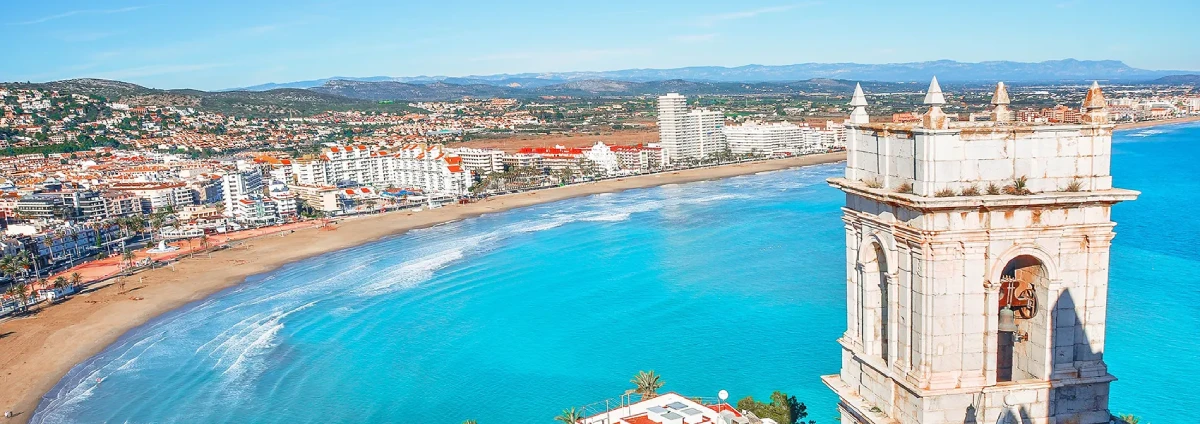
The average annual temperature on the coast is around 18°C. Sunshine is exceptional, often exceeding **300 sunny days per year**. For a property owner, this means extended use of outdoor spaces (terraces, swimming pools) and a very broad seasonal rental demand.
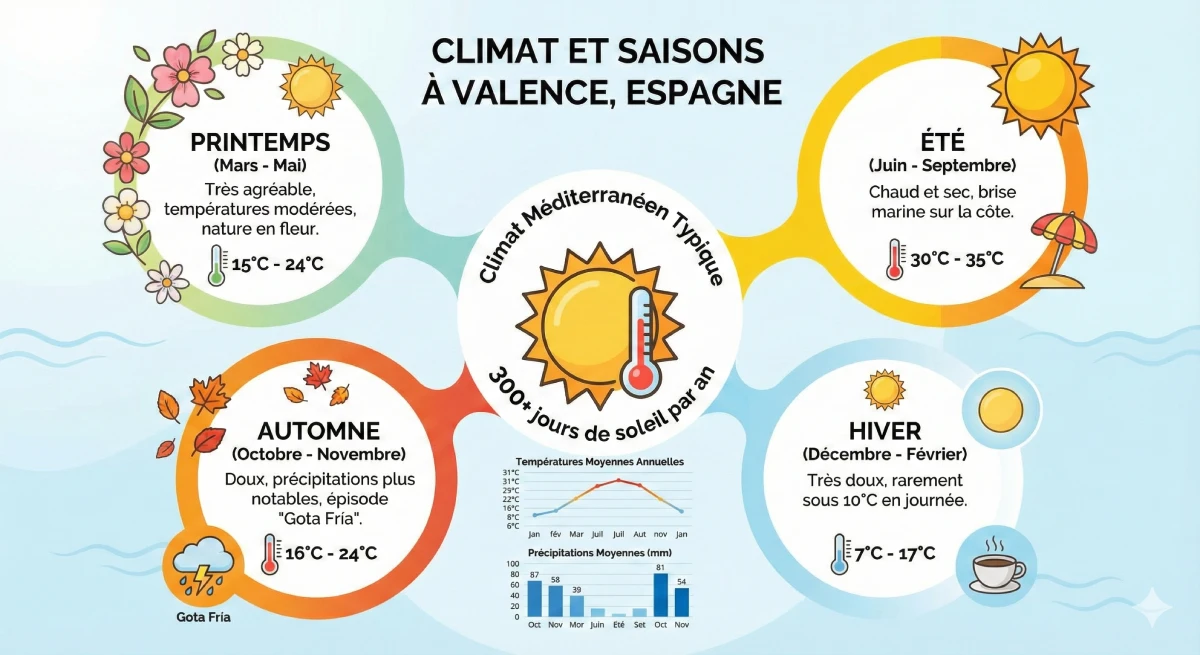
- ☀️ Summer (June - September): Hot and dry, with average highs of 30°C to 35°C. The sea breeze makes the heat bearable on the coast.
- 🍂 Autumn (October - November): Mild, but this is when the most significant rainfall occurs, particularly during the "Gota Fría" (cold drop) phenomenon.
- ❄️ Winter (December - February): Very mild. Daytime temperatures rarely drop below 10°C. This is ideal for escaping the harsh winters of Northern Europe.
- 🌸 Spring (March - May): Very pleasant, with moderate temperatures and nature in bloom. It's a perfect season to visit properties.
Climate Data: Valencia
Valencia, the capital of the community, perfectly exemplifies this climate. The data below is crucial for anticipating a property's energy needs (air conditioning in summer, minimal supplementary heating in winter).
| Month | Min Temp (°C) | Max Temp (°C) | Rainfall (mm) |
|---|---|---|---|
| January | 6 | 16 | 26 |
| February | 7 | 17 | 27 |
| March | 9 | 20 | 28 |
| April | 11 | 21 | 36 |
| May | 15 | 24 | 32 |
| June | 19 | 28 | 14 |
| July | 22 | 31 | 3 |
| August | 22 | 31 | 10 |
| September | 20 | 28 | 46 |
| October | 16 | 24 | 81 |
| November | 10 | 19 | 54 |
| December | 7 | 16 | 29 |
This infographic summarizes seasonal variations, a key factor for rental investment in Valencia.
Comparison: Alicante and Castellón
The Valencian Community spans several provinces. While the climate is generally similar, microclimates exist, influencing investment choices.
Alicante's Microclimate (Costa Blanca)
Alicante, located further south, enjoys a semi-arid climate. It is often considered to have one of Spain's best climates, with even less rain than Valencia and exceptionally mild winters. The surrounding mountains protect it from cold winds. With almost 300 days of sunshine per year, it's a paradise for buyers seeking maximum sun exposure.
- Property Highlights: Very high rental demand throughout the year. Virtually non-existent heating costs.
- Points to Consider: Very hot summers that may require efficient air conditioning.
Valencia vs. Castellón (Costa del Azahar)
Valencia (central) and Castellón (north) present slight differences. Valencia is a large metropolis with a distinctly Mediterranean climate. Castellón, further north, is a little more exposed to winds and may experience slightly cooler and wetter winters than Valencia, but remains extremely pleasant.
| City | Avg. Temp (°C) | Sunshine (h/year) | Rainfall (mm/year) |
|---|---|---|---|
| Valencia | 18.4°C | ~2 700 h | ~475 mm |
| Alicante | 18.9°C | ~3 000 h | ~311 mm |
| Castellón | 17.8°C | ~2 750 h | ~440 mm |
When to Visit (and Buy) in the Valencian Community?
The 'when' depends on your objective. From a real estate perspective, each season offers distinct advantages for a buyer.
- Spring (March-May): Often considered the **best time to visit** properties. The light is excellent, temperatures are ideal (15°C-22°C), and gardens are in bloom, showcasing properties at their best.
- Summer (June-September): Ideal for testing the area's rental appeal and air conditioning efficiency. This is the peak tourist season.
- Autumn (Oct.-Nov.): Allows you to see how properties handle rainfall (rare but intense). The market is calmer, potentially offering better negotiation opportunities.
- Winter (Dec.-Feb.): The best time to **evaluate the "true" cost of living**. You can test a property's insulation, humidity, and heating. It's the low season, perfect for prospecting without pressure.
Local Weather Phenomena to Know
While the climate is excellent, two phenomena are worth knowing about, particularly for property maintenance.
The "Gota Fría" (Cold Drop)
This phenomenon, occurring mainly in **autumn (September/October)**, is an episode of very localized and intense torrential rainfall. Warm, humid air from the Mediterranean meets cold air at altitude, causing violent thunderstorms.
Real Estate Impact: When purchasing, it is crucial to check the quality of drainage, the waterproofing of the roof and windows, and whether the property is located in a flood-prone area (especially for villas with basements).
Dominant Winds
The region is subject to various winds, such as the Levante (easterly wind, humid, which can bring rain) and the Poniente (westerly wind, dry and hot, which can exacerbate heatwaves in summer). The orientation of a terrace or a house relative to these winds will influence its thermal comfort.
Activities and Lifestyle According to the Weather
The climate dictates an outdoor-oriented lifestyle:
- In summer: Enjoy the beaches, water sports, and outdoor festivals.
- In spring: Discover traditional festivals like Las Fallas in Valencia, where the mild climate is ideal for festivities.
- In autumn: Stroll through natural parks or sample local products.
- In winter: Visit museums, historical monuments, and enjoy a quieter tourism experience.
Practical Advice for Future Residents
If you are considering settling or investing in Valencia, here is some climate-related advice:
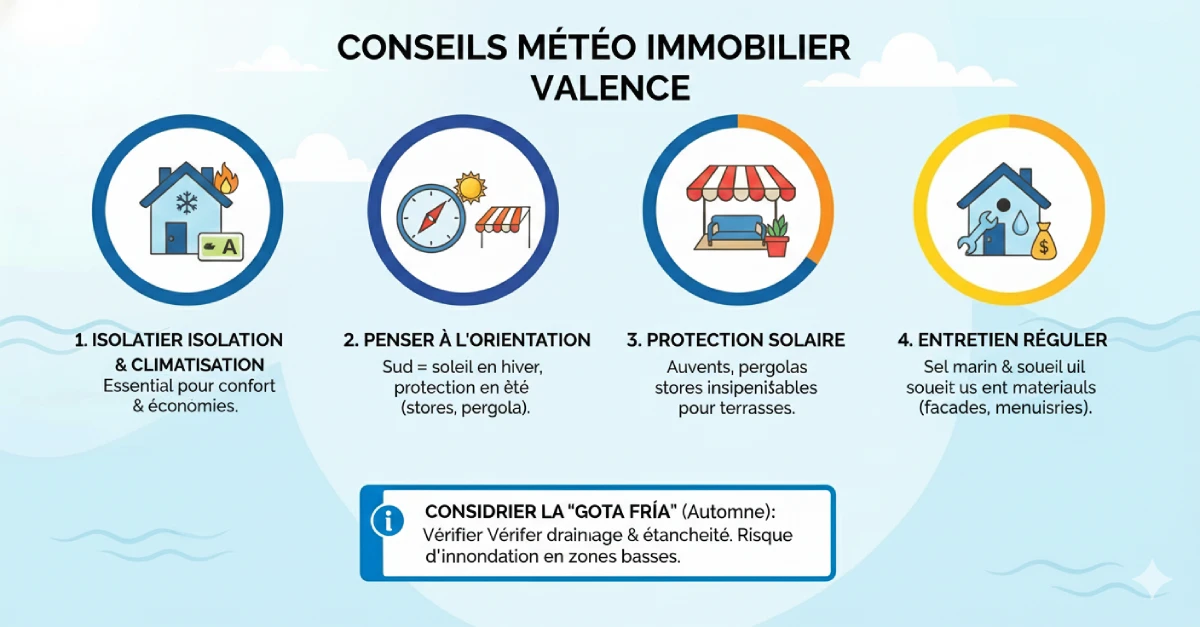
- Check insulation and air conditioning: Good reversible air conditioning (hot/cold) is essential. Check the property's energy efficiency (EEC).
- Consider orientation: A south-facing orientation is sought after in winter to capture the sun, but will require good blinds or a pergola in summer.
- Sun protection: Awnings (toldos), pergolas, and blinds are essential for enjoying terraces.
- Maintenance: Sea salt (proximity to the sea) and intense sun can wear down materials. Budget for the maintenance of facades and joinery.
Conclusion
The weather in Valencia and its community is undoubtedly one of its major assets for a real estate project. With over 300 days of sunshine, mild winters, and an outdoor-oriented lifestyle, the region offers an unparalleled quality of life. Understanding the nuances between Alicante's drier climate and the more temperate one of Valencia or Castellón is essential for targeting your investment.
Don't forget to check the weather in Spain and consider local particularities like the "Gota Fría" during your visits. A climate-adapted property is a comfortable and energy-efficient property all year round.

A Project Under the Valencia Sun?
Take advantage of market opportunities. Let's discuss your project.
Article Summary
- Introduction
- General Climate of the Valencian Community
- Climate Data: Valencia
- Comparison: Alicante and Castellón
- Alicante's Microclimate (Costa Blanca)
- Valencia vs. Castellón (Costa del Azahar)
- When to Visit (and Buy) in the Valencian Community?
- Local Weather Phenomena to Know
- The "Gota Fría" (Cold Drop)
- Dominant Winds
- Activities and Lifestyle According to the Weather
- Practical Advice for Future Residents
- Conclusion
FAQ: Climate and Real Estate in the Valencian Community
Our real estate experts answer your questions regarding the impact of weather in Valencia, Alicante, and Castellón on your property investment.
The main difference lies in humidity. Alicante (Costa Blanca) has a semi-arid climate, receiving significantly less rainfall (around 311 mm/year) than Valencia (approximately 475 mm/year). Consequently, winters in Alicante are perceived as milder and drier. Valencia is slightly more humid, which is particularly noticeable in summer.
Yes, supplementary heating is essential. Although daytime temperatures are mild (16-18°C), nights are cool (6-9°C), and the humidity can create a penetrating cold sensation, especially in older apartments. Reversible air conditioning (AC) is the most common and effective solution.
For most people, yes, it is essential. From mid-July to the end of August, Valencia and Alicante experience peaks of 35°C, but it's primarily the high humidity levels (especially in Valencia) that make the heat feel "sticky" and difficult to bear, particularly at night. This is a non-negotiable criterion for comfort and rental potential.
This phenomenon of torrential rains (September-October) is brief but intense. The danger depends on your property's location. During viewings, always check:
- That the property is not located in a dry riverbed ("rambla").
- The quality of drainage on terraces and roof terraces.
- The waterproofing of windows and garages/basements.
A well-constructed property in a non-floodable area is generally safe.
A South-East (Sureste) orientation is often considered the best. It allows properties to capture the morning sun (ideal in winter) without suffering from the scorching afternoon sun in summer (West), which can overheat apartments. A North (Norte) orientation should be avoided as it will be cold and damp in winter.
Yes, a significant difference. The coastal climate is regulated by the sea (milder in winter, tempered by the sea breeze in summer). Just 20-30 km inland, the climate becomes more continental: summers are hotter (often 40°C+, with no sea breeze) and winters are colder, with potential frosts.
The microclimate of the Costa Blanca (Alicante region) is often cited by the World Health Organization (WHO) as one of the healthiest in the world. Constant sunshine (Vitamin D) and mild winters are particularly beneficial for individuals suffering from rheumatism, arthritis, or respiratory problems.
This is a dreaded wind in summer. The "Poniente" (or "Ponent") is a westerly wind originating from inland areas. It is extremely hot and dry, giving a "hairdryer"-like sensation. It causes temperatures to rise instantly and increases the risk of wildfires.
The "Levante" (or "Llevant") is the opposite: it comes from the East (from the sea). It is humid. In summer, it can make the atmosphere feel heavy, but it also brings clouds that sometimes provide sun protection. In autumn, this moisture-laden wind fuels the Gota Fría episodes.
Absolutely. Castellón (Costa del Azahar) is an underrated option. Its climate is very similar to Valencia's, perhaps very slightly cooler in winter. It is a less urbanized and more authentic area, offering excellent value for money for a real estate investment with a premium Mediterranean climate.
It can cause problems in poorly ventilated or insulated properties. This is a crucial point to check during viewings: look at ceiling corners and inside wardrobes (especially those against an exterior wall). Good mechanical ventilation (VMC) or daily airing is necessary.
For a property purchase, visit during two opposing periods:
- In February: To experience the "worst" of winter (cold, humidity, heating needs).
- In August: To experience the "worst" of summer (stifling heat, humidity, AC needs).
If you can withstand these two extremes, you'll enjoy the property year-round.
The temperature of the Mediterranean Sea drops to its lowest in February, around 14-15°C. It's cold, but brave swimmers (often expatriates from Northern Europe) swim year-round. For most people, the comfortable swimming season extends from late May to October.
Maintenance is required year-round. In summer, intense sun and heavy use necessitate very regular checks of chlorine and pH levels. In autumn, rains (sometimes muddy) and winds can quickly dirty the water. It is common to hire a maintenance service (around €80-120/month).
In Spain, extraordinary damages (floods, earthquakes, etc.) are covered by the "Consorcio de Compensación de Seguros", a public body. This coverage is automatically included in most basic home insurance policies. Therefore, it is crucial for UK/US investors to have insurance, even a simple one, to be protected.


