
How to Obtain a Tourist Rental License in Alicante Province?

Introduction
Alicante Province is a dream destination for millions of tourists every year. If you own a property here, putting it up for short-term rental is an excellent source of income. But be aware, this activity is highly regulated. The most important step before publishing your listing on Airbnb, Booking.com, or any other portal is to obtain your tourist rental license.
But where do you start? Who issues this crucial permit? The answer is simpler than it seems, but the process demands rigor and a deep understanding of local specificities. As local real estate experts, we guide you through this critical step.
The Competent Authority: Turisme Comunitat Valenciana
The first thing to know is that tourism competence does not depend on your local town hall (Ayuntamiento) or Alicante province, but on the autonomous region.
For the entire Alicante province, the sole official body that issues tourist rental licenses is Turisme Comunitat Valenciana. This is the tourism department of the Valencian Community government. You can consult their official portal here, a reliable source on the matter.
In summary: Whether your property is in Alicante city, Jávea, Dénia, Benidorm, Torrevieja, or a small inland village, the final application must be made to the same regional body.

The Process: The "Declaración Responsable"
You don't truly "apply" for a license in the same way you would for a building permit. The procedure consists of submitting a "Declaración Responsable" (Responsible Declaration or sworn declaration).
Through this document, you declare, under your responsibility, that your property meets all legal conditions and requirements to be a tourist rental. Once the declaration is properly submitted, you receive a registration number that allows you to start the activity legally.
Important: Moratorium on Licenses in Alicante City
It is crucial to note that, at present, Alicante city has implemented a moratorium and is no longer issuing new tourist rental licenses in many areas of the city. This measure aims to combat market saturation and rising prices for residents. It has therefore become extremely difficult, if not impossible, to register a new tourist accommodation in the capital.
Faced with this situation, investors must turn to other municipalities in the province that continue to grant licenses. Cities like Torrevieja, Orihuela Costa, or areas like Ciudad Quesada (Rojales) represent excellent alternatives where the process remains open, provided local urban planning regulations are respected.

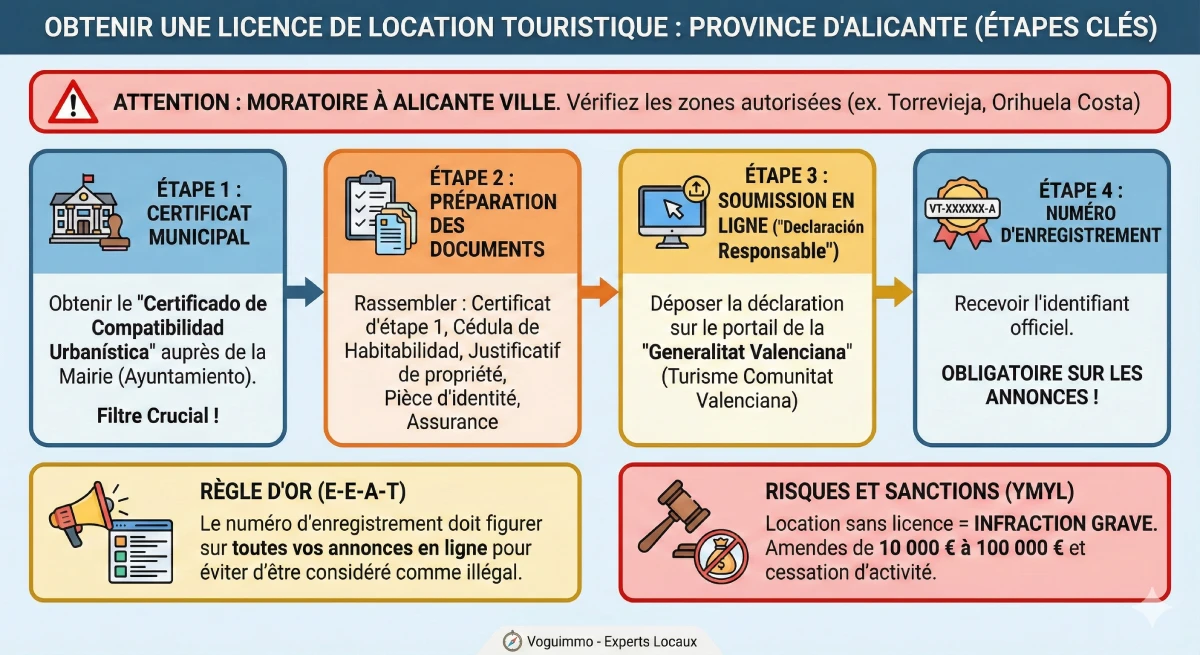
Key Steps to Obtain Your License
The process unfolds in several stages, with the town hall playing a crucial preparatory role.
Step 1: The Essential Document from the Town Hall (Ayuntamiento)
Even before contacting the regional tourism office, you must obtain an essential document from your town hall's urban planning department: the "Certificado de Compatibilidad Urbanística" (Urban Compatibility Certificate).
This certificate attests that the tourist use of your property is compatible with your municipality's local urban plan. This is the most important filter: if the town hall refuses to issue it (as is the case in Alicante city), you will not be able to proceed further.
Step 2: Preparing the Necessary Documents
Once you have the compatibility certificate in hand, gather the following documents:
- Certificado de Compatibilidad Urbanística (obtained in Step 1).
- Valid Licencia de Segunda Ocupación or Cédula de Habitabilidad (occupancy certificate).
- Proof of ownership (deed of sale, nota simple...).
- Owner's identification (NIE/DNI).
- Civil liability insurance is highly recommended and often required.
Step 3: Submitting the "Declaración Responsable"
Submission is primarily done online via the Generalitat Valenciana portal (sede electrónica). For this, you will need a Spanish digital certificate.
You will complete a detailed form providing all information about your property (capacity, characteristics, services...) and attach the required documents.
Step 4: Obtaining the Registration Number
Once your complete application has been submitted, you will obtain your tourist registration number. For Alicante province, it will have the following format: VT-XXXXXX-A.
Golden Rule
This number is your official identifier. It must be displayed on all your online listings and advertising materials. The absence of this number is the primary sign of an illegal rental and is subject to severe fines.
Summary Table of Authorities
| Authority | Role | Action Required |
|---|---|---|
| Your Local Town Hall (Ayuntamiento) | Validate urbanistic compatibility | Obtain the "Certificado de Compatibilidad Urbanística" |
| Turisme Comunitat Valenciana | Register the property and issue the license | Submit the "Declaración Responsable" and receive the registration number |
What Happens if I Rent Without a License?
The authorities of the Valencian Community are becoming increasingly strict, and inspections are frequent. Renting without a license is considered a serious infraction, and the fines are very dissuasive, ranging from €10,000 to €100,000. Do not take this risk!
| Infraction | Risk |
|---|---|
| Absence of registration number on an advertisement | Fine (for you and for platforms like Airbnb) |
| Renting without a license | Severe fine (€10,000 - €100,000) + cessation of activity |
Conclusion
Obtaining a tourist rental license is a precise but entirely achievable administrative process, provided you choose the right locality. The current moratorium in Alicante city necessitates exploring other attractive areas of the province. The crucial step remains obtaining approval from the relevant municipal town hall before commencing any other procedure.
The language barrier and administrative specificities can be a deterrent. Our agency is experienced in assisting property owners throughout this process. We can verify the viability of your project, help you gather the necessary documents, and manage the submission of your application.
Table of Contents
- Introduction
- The Competent Authority: Turisme Comunitat Valenciana
- The Process: The "Declaración Responsable"
- Important: Moratorium on Licenses in Alicante City
- Key Steps to Obtain Your License
- Step 1: The Essential Document from the Town Hall (Ayuntamiento)
- Step 2: Preparing the Necessary Documents
- Step 3: Submitting the "Declaración Responsable"
- Step 4: Obtaining the Registration Number
- Summary Table of Authorities
- What Happens if I Rent Without a License?
- Conclusion
FAQ: Tourist Rental License in Alicante
Investing in short-term rental properties in the province of Alicante offers an attractive income stream. Understanding the procedures and requirements to obtain your tourist rental license is essential for a smooth and legal operation.
In Spain, and specifically in the Valencian Community, the rental of properties for tourist purposes is a highly regulated activity. Obtaining a tourist rental license is not only a legal obligation but also a guarantee for tenants and a means for authorities to control the supply and quality of accommodation. Without this permit, you cannot legally list your property on platforms like Airbnb or Booking.com, under penalty of severe sanctions.
Contrary to popular belief, tourism jurisdiction does not fall under the local town hall (Ayuntamiento), but under the autonomous region. For the entire province of Alicante, the sole and official body that issues licenses is Turisme Comunitat Valenciana, the tourism department of the Valencian Community government. All applications must be submitted to this regional entity.
Yes, the final issuing body, Turisme Comunitat Valenciana, is the same for all municipalities in the Valencian Community. However, it is crucial to note that preliminary requirements can vary significantly from one municipality to another, particularly regarding urban planning compatibility. The local urban planning regulations of each Town Hall (Ayuntamiento) serve as an essential filter and can make obtaining a license impossible in certain areas, as is the case in Alicante city.
It's not a classic "application" for a license, but rather the submission of a "Declaración Responsable" (Declaration of Responsibility). Through this document, the owner formally declares, under their own responsibility, that their property meets all the legal conditions and requirements to be operated as a tourist rental. Once this declaration is correctly submitted, a registration number is assigned, allowing the activity to commence legally.
The "Declaración Responsable" (Declaration of Responsibility) is a strong legal act. By submitting it, the owner commits to:
- Ensuring their property complies with current tourism legislation.
- Possessing all required supporting documents (certificates, insurance, etc.).
- Maintaining this compliance throughout the duration of the activity.
It is a full and complete acknowledgment of responsibility. Authorities can conduct post-submission checks, and in case of non-compliance, severe penalties will be applied retroactively.
Yes, this is a crucial point. The city of Alicante has implemented a moratorium, a temporary suspension, and no longer issues new tourist rental licenses in many areas of the city. This measure aims to regulate the rental market and combat saturation. It has therefore become extremely difficult, if not impossible, to register a new tourist accommodation in the capital. Investors must imperatively take this into account when acquiring a property in Alicante city itself.
Given Alicante city's moratorium, investors should look to other municipalities in the province that continue to grant licenses. Cities like Torrevieja, Orihuela Costa, or areas such as Ciudad Quesada (Rojales) are excellent alternatives. These municipalities often offer more favorable conditions, provided, of course, that local urban planning regulations are strictly adhered to. A preliminary analysis of urban planning compatibility is always the first step.
Even before contacting the regional tourism office, the most fundamental step is to obtain the "Certificado de Compatibilidad Urbanística" (Certificate of Urban Planning Compatibility) from the urban planning department of your local Town Hall (Ayuntamiento). This document certifies that the tourist use of your property is compatible with the urban planning regulations in force in your municipality. Without this certificate, all subsequent procedures with Turisme Comunitat Valenciana will be blocked.
The "Certificado de Compatibilidad Urbanística" (Certificate of Urban Planning Compatibility) is the most critical filter in the process. Its role is to confirm that tourist rental activity is authorized for your property, based on its location and the municipality's urban planning regulations. If the Town Hall denies you this certificate – as is the case in areas affected by the moratorium in Alicante city – it means your tourist rental project is not legally viable in that location. This is the first check to perform to avoid fruitless investments.
Once the Certificate of Urban Planning Compatibility is obtained, you will need to gather a series of essential documents:
- The Certificado de Compatibilidad Urbanística (Certificate of Urban Planning Compatibility), issued by the Town Hall.
- The Licencia de Segunda Ocupación or Cédula de Habitabilidad (Certificate of Occupancy or Habitation Certificate), valid and attesting that the property meets minimum habitability conditions.
- Proof of property ownership, such as the deed of sale (escritura) or a nota simple (extract from the property registry).
- Your identification document: the NIE (Foreigner Identification Number) if you are a foreign resident, or the DNI (National Identity Document) if you are Spanish.
- Public liability insurance, highly recommended and sometimes required by regional legislation to cover risks associated with the activity.
The submission of the Declaración Responsable is primarily done electronically. Here are the steps:
- Access the portal: Log in to the electronic headquarters (sede electrónica) of the Generalitat Valenciana.
- Digital certificate: To identify yourself and electronically sign the document, you will need a Spanish digital certificate (e.g., the FNMT Digital Certificate).
- Complete the form: Fill out the detailed online form with all information regarding your property (capacity, characteristics, services offered, etc.).
- Attach documents: Upload all required documents prepared in the previous steps (Certificate of Urban Planning Compatibility, Certificate of Occupancy, proof of ownership, NIE/DNI, etc.).
- Submission: Validate and electronically submit your application.
Once the complete application is submitted, you will obtain your tourist registration number.
In the province of Alicante, the tourist registration number follows a specific format: VT-XXXXXX-A. This number is much more than a mere administrative reference; it is your official identifier and proof of the legality of your activity. It is mandatory to include it on all your online listings (on booking platforms, your website, etc.) and on any advertising material. The absence of this number is a direct sign of an illegal rental and exposes the owner to heavy penalties.
Obtaining the license involves coordination between two main entities, each with a well-defined role:
| Body | Main Role | Owner's Required Action |
|---|---|---|
| Your Town Hall (Ayuntamiento) | Validate the urban planning compatibility of the property with local regulations. | Obtain the Certificado de Compatibilidad Urbanística (Certificate of Urban Planning Compatibility). |
| Turisme Comunitat Valenciana | Register the property as a tourist accommodation and issue the license number. | Submit the Declaración Responsable (Declaration of Responsibility) and receive the registration number. |
Understanding this division of roles is essential for navigating the process effectively.
Authorities in the Valencian Community are stepping up controls, and renting without a license is considered a serious offense. The penalties are very dissuasive and aim to deter any illegal activity. Fines can range from €10,000 to €100,000, depending on the severity of the infraction. Beyond the fine, an injunction to cease the activity may be issued. Never underestimate this financial and legal risk; compliance is the only viable path.
At Voguimmo, we are senior Spanish real estate experts and legal professionals, accustomed to the administrative and legal specifics of the Valencian Community. We understand that the language barrier and the complexity of procedures can be a hindrance for UK/US investors. We offer comprehensive support that includes:
- Verifying the viability of your project in the chosen locality.
- Assisting with the collection and preparation of all necessary documents.
- Managing and submitting your Declaración Responsable application to the competent bodies.
Our goal is to ensure a smooth process and the legal success of your tourist rental project.


