
What is the Tarjeta Sanitaria (Health Card) and the S1 Form for Retirees?

Introduction
For many international retirees, buying property in Spain is the culmination of a life project. But once the dream of a finca or a sea-view apartment is secured, a crucial question arises: "How will I be covered for healthcare?". Spain boasts an excellent public healthcare system (the *Sistema Nacional de Salud* - SNS), and for EU retirees, access to this system relies on two essential documents: the S1 Form and the Tarjeta Sanitaria.
Understanding the difference and connection between these two elements is key to a successful and peaceful expatriation. The S1 is the "entry key" you must obtain in your country of origin, while the Tarjeta Sanitaria is the physical "access card" you will receive once in Spain. This expert guide demystifies the step-by-step process for future retired residents.
What is the "Tarjeta Sanitaria"?
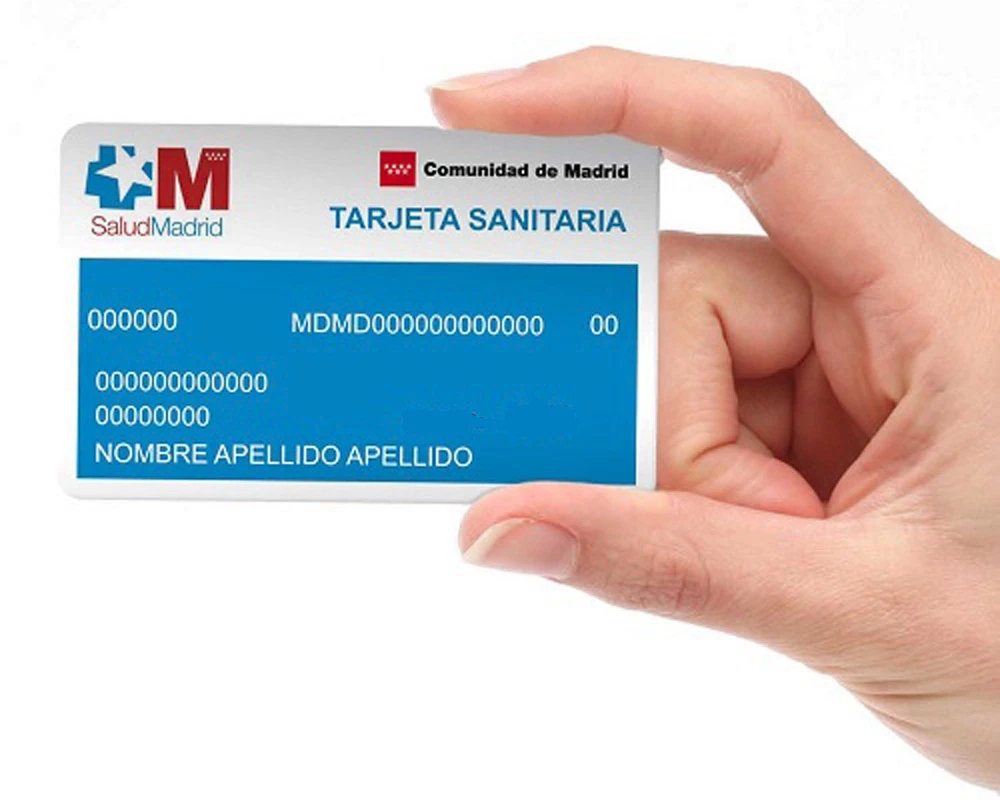
The Tarjeta Sanitaria (health card) is the physical, personal, and non-transferable document that identifies you as a user of Spain's public healthcare system (SNS). It is the equivalent of an NHS card in the UK or a national health card in other EU countries for accessing care.
This card is assigned to you by your autonomous community (e.g., Valencian Community, Andalusia) and is essential for:
- ✅ Registering with a family doctor (médico de cabecera) at your local health centre (Centro de Salud).
- ✅ Obtaining appointments with specialists (upon referral from your doctor).
- ✅ Benefiting from coverage for prescription medications (with a co-payment, or *copago*, which depends on your income).
- ✅ Being admitted to public hospitals.
The S1 Form: The Access Key for EU Retirees
The S1 Form (which replaces the old E106, E109, and E121 forms) is a portable European document. Its purpose is to transfer your healthcare rights from your country of origin (where you contributed and receive your pension) to Spain (where you reside).
In other words, by presenting the S1 to the Spanish administration, you prove that you are entitled to healthcare coverage, and your pension fund (e.g., your national social security institution) will reimburse the Spanish State for the care you receive. It is not necessary to purchase private insurance to obtain residency if you have this form.
Who Can Apply for the S1 Form?
This form is specifically for EU/EEA/Swiss citizens who:
- 1. Will reside in another member state (Spain).
- 2. Receive a state **pension** from their country of origin.
- 3. Are **not** actively working in Spain (in which case they would contribute directly to Spanish social security).
Expert Tip
Apply for your S1 form from your health insurance provider (e.g., your national social security institution) **at least 2 to 3 months before your move**. It is essential to have it in hand upon your arrival in Spain to begin the process.
Process, Documents, and Pitfalls to Avoid
Obtaining the Tarjeta Sanitaria via the S1 is a multi-step process that connects the administrations of two countries. Here's the exact path we follow for our retired clients.
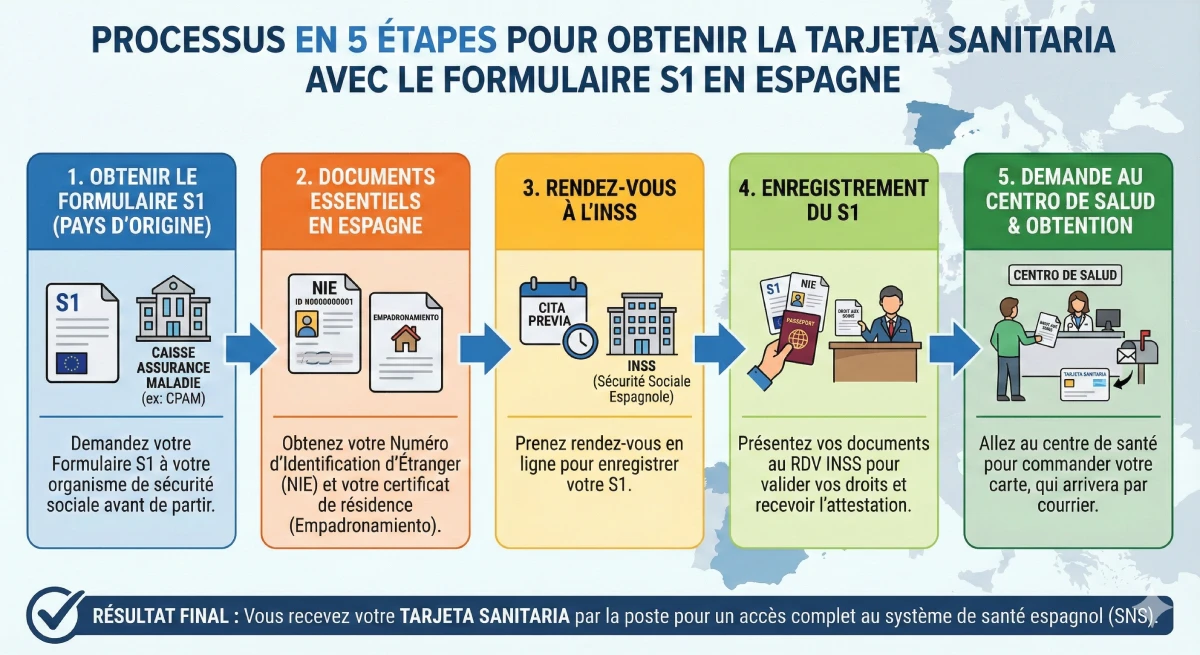
The Step-by-Step Guide: From S1 to Tarjeta
- Before You Depart (Home Country): Apply for your S1 Form from your health insurance institution (e.g., national social security agency).
- Upon Arrival in Spain: Obtain your basic documents: your NIE (Foreigner Identification Number) and your Empadronamiento (municipal registration certificate).
- Step 1 (INSS): Make an appointment (Cita Previa) at the **Instituto Nacional de la Seguridad Social (INSS)**. This is the Spanish body that manages social security.
- Step 2 (S1 Submission): At your INSS appointment, present your S1, NIE, Empadronamiento, and passport. The agent will register your S1 and provide you with a document certifying your right to healthcare benefits (documento acreditativo del derecho a la asistencia sanitaria).
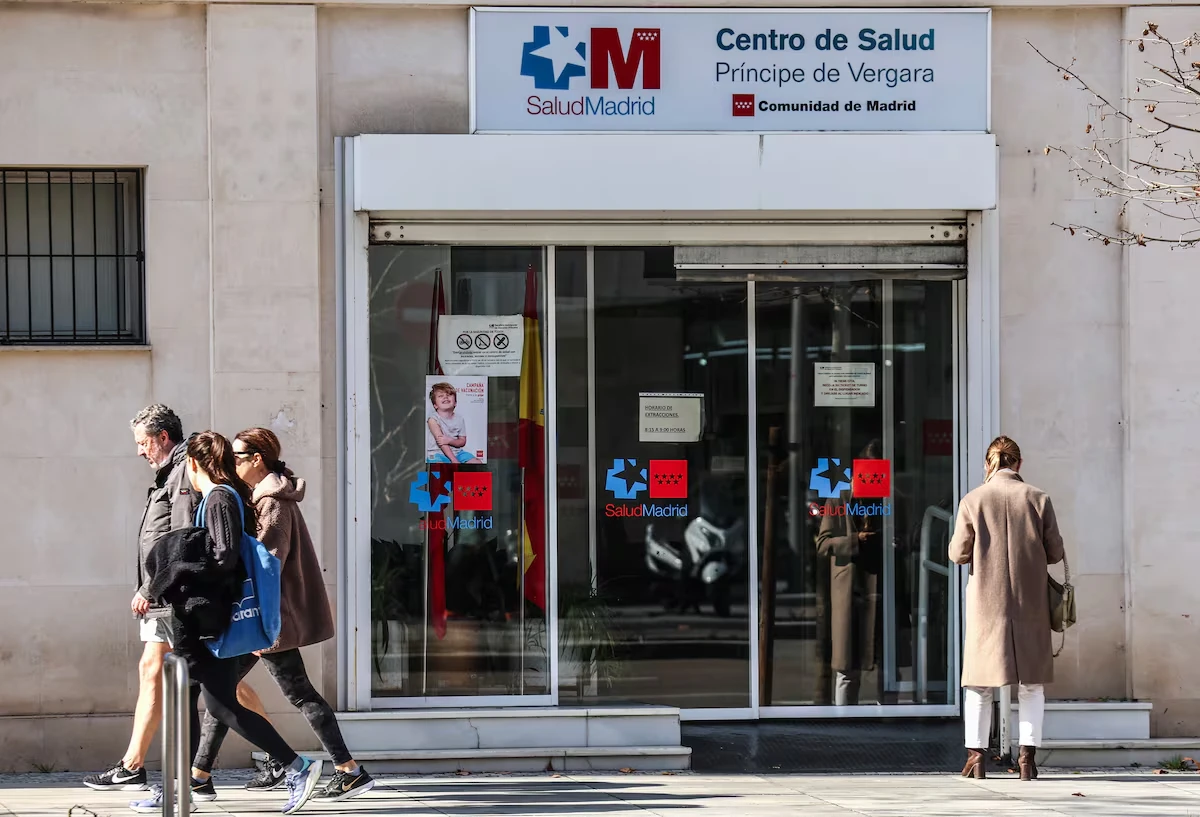
- Step 3 (Centro de Salud): With this document from the INSS, go to the **Centro de Salud** (local health centre) in your neighbourhood (the one indicated on your Empadronamiento).
- Step 4 (Obtaining the Card): The health centre will register you, assign you a doctor, and order your physical **Tarjeta Sanitaria**, which will arrive by mail at your Spanish address a few weeks later.
Summary Table of Documents
| Step | Required Documents | Where to Obtain? |
|---|---|---|
| Obtain the S1 | Proof of Pension/Retirement | Health insurance institution in your country of origin |
| Obtain NIE / Empadronamiento | Passport, proof of address | Police Station (NIE) / Town Hall (Empadronamiento) |
| Register the S1 (INSS) | S1 Form, NIE, Empadronamiento, Passport | INSS Office (by appointment) |
| Apply for the Tarjeta Sanitaria | INSS document, NIE, Empadronamiento | Centro de Salud (Local Health Centre) |
Pitfall #1: Confusing the S1 Form with the EHIC (European Health Insurance Card)
This is the most common mistake. The EHIC (European Health Insurance Card) is designed for temporary stays (holidays, weekends). It covers medically necessary and unexpected treatment. The S1 Form is designed for permanent residents (expats, retirees). You cannot use an EHIC as proof of healthcare coverage to obtain residency in Spain.
| Feature | S1 Form | EHIC (European Card) |
|---|---|---|
| Purpose | Permanent Residency (+3 months) | Temporary Stay (Holidays) |
| What it allows | Full access to the public healthcare system (SNS) via the Tarjeta Sanitaria | Access to urgent/unexpected public healthcare |
| Final Document | Tarjeta Sanitaria (Spanish card) | You use your EHIC from your home country |
Official Resource
For official and detailed information on your retirement and healthcare rights in Spain, we recommend consulting the portal of **CLEISS** (Centre for European and International Social Security Liaisons) of the French government.
Consult the official France -> Spain information sheet.
Conclusion
For an EU retiree, securing healthcare access in Spain is a straightforward but rigorous process. The S1 Form is the "golden key" that you absolutely must request in your country of origin before you leave. Once in Spain, this S1, combined with your NIE and Empadronamiento, will open the door to the INSS, which will provide you with the final document to obtain your Tarjeta Sanitaria at your health centre.
Do not neglect this administrative step: it guarantees a peaceful retirement in the sun, granting you the same rights and access to healthcare as any Spanish citizen. It is an administrative step as fundamental as the signing of your property deed (Escritura).
Article Summary
- Introduction
- What is the "Tarjeta Sanitaria"?
- The S1 Form: The Access Key for EU Retirees
- Who Can Apply for the S1 Form?
- Process, Documents, and Pitfalls to Avoid
- The Step-by-Step Guide: From S1 to Tarjeta
- Summary Table of Documents
- Pitfall #1: Confusing the S1 Form with the EHIC (European Health Insurance Card)
- Conclusion
FAQ: Healthcare and Retirement in Spain (S1 & Tarjeta Sanitaria)
All you need to know about the S1 Form, Tarjeta Sanitaria, and accessing healthcare for international retirees in Spain
The Tarjeta Sanitaria is a physical, personal, and non-transferable health card that identifies you as a user of the Spanish public healthcare system (SNS). It functions similarly to an NHS medical card or a health insurance card, providing access to care, doctors, and hospitals.
The S1 Form is a European portable document that allows you to transfer your healthcare entitlements from your country of origin (where you receive your pension) to Spain (where you reside). It serves as the administrative 'key' to accessing Spanish public healthcare.
The S1 Form is for permanent residents and grants full access to the Spanish healthcare system. The EHIC (European Health Insurance Card) is only for temporary stays (holidays) and exclusively covers emergency care. You cannot use an EHIC to establish permanent residency.
No. If you are a retiree from the UK or EU with an S1 form, you have access to the free public healthcare system (SNS) in Spain. It is not necessary to take out private insurance to obtain your legal residency based on S1 entitlement.
The S1 is for citizens of the UK, EU/EEA, or Switzerland who receive a state pension from their country of origin and plan to reside in Spain without working. Please note: US citizens are generally not eligible for the S1 form and will typically need private health insurance to obtain residency.
You should apply for the S1 from your health insurance provider in your country of origin. For UK citizens, this is typically the NHS Business Services Authority (NHSBSA). You should apply at least 2 to 3 months before your departure.
Before even considering healthcare, you must obtain your NIE (Número de Identificación de Extranjero - Foreigner Identification Number) and your 'Empadronamiento' (a certificate of residence from your local town hall). These documents are required by the social security authorities.
The INSS (Instituto Nacional de la Seguridad Social) is the body that manages social security in Spain. You must make an appointment there to register your S1 form and prove your entitlement to healthcare coverage.
Once your entitlement is validated by the INSS, you must go to your local 'Centro de Salud' (health centre) with the document from the INSS and your 'Empadronamiento' to order the card.
After your registration at the 'Centro de Salud', the physical card is usually sent by post to your Spanish home address a few weeks later.
It is essential for registering with a family doctor, obtaining appointments with specialists, being admitted to a public hospital, and benefiting from prescription medication coverage at pharmacies.
Yes, prescription medications are covered, but with a co-payment ('copago'). The amount you pay (often 10% for retirees, with a monthly cap) depends on your income.
Yes. Upon registration at the 'Centro de Salud', a family doctor ('médico de cabecera') is assigned to you, but you generally have the option to change doctors if you wish.
The provisional paper document provided by the INSS ('documento acreditativo del derecho') or by the 'Centro de Salud' upon registration is usually sufficient to prove your entitlements while you await the card.
Yes. For UK citizens, the NHS Business Services Authority (NHSBSA) is the official reference for understanding S1 entitlements and transfers. For other international buyers, you should consult your national social security or health authority to understand your eligibility and requirements.


